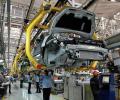
Automobile manufacturers are likely to report strong numbers for the September quarter of Financial Year 2023-24 (Q2 FY24), riding on growth across segments and offset by a marginal drop in overall two-wheeler (2W) volumes. Higher average selling price (ASP) year-on-year (YoY), which was necessitated by price hikes taken by original equipment manufacturers (OEMs), and an improved product mix will also aid revenues and margins. Moreover, commodity prices are down on a YoY basis, leading to higher margins in earnings before interest, taxes, depreciation and amortisation (Ebitda).

"Lady candidates need not apply." So read the postscript in a job notice from Telco (now Tata Motors) on a notice board in the corridors of the Indian Institute of Science, Bangalore (now Bengaluru), in 1974. Irked, Sudha Murty, who was then pursuing her masters in computer science at the institute, wrote a postcard to JRD Tata, expressing her surprise at this gender discrimination, especially since the Tata Group were pioneers on many fronts. Shortly, Murty became the first woman on the firm's shop floor.

Nirma's tryst with the pharmaceutical space started in 2006 when it acquired the ailing Core Healthcare in a deal reported to be worth Rs 300 crore. The Ahmedabad-based manufacturer of intravenous fluids was subsequently renamed Nirlife. Pharma industry insiders say Nirma, which broke open the detergent market in the 1990s with low prices and massive advertising, tried an encore of the low-price strategy in pharma, but with mixed results.

Indian lenders are unlikely to clear the vertical split of BSE-listed Vedanta Ltd in a hurry, considering that the demerger would reduce the fungibility of cash flows across businesses and increase their volatility, according to analysts. The demerger plan, which would result in six separate listed entities, would require approval from shareholders, lenders and other statutory bodies. "We believe that a separate listing of different businesses would reduce the fungibility of cash flows across businesses and increase the volatility of cash flows.

India's pharmaceutical exports to Iran have been hit owing to depleting rupee reserves in the West Asian country because of India stopping the import of crude oil from it in 2019 following US sanctions. Pharmaceutical exports dropped 71.25 per cent in April-August this year over the same period last year. The data from the Pharmaceutical Exports Promotion Council (Pharmexcil) showed exports to Iran had declined 31.29 per cent in 2022-23 as against the previous financial year.

Drug major Cipla on Tuesday said it has launched drone-powered deliveries of critical medicines - cardiac, respiratory and other essential chronic therapies - to hospitals and pharmacies across Himachal Pradesh in partnership with Skype Air Mobility, a Gurugram-based drone delivery company. Cipla is the first among large Indian pharmaceutical companies to adopt drone-based deliveries to facilitate expedited supply to stockists in remote areas, it claimed. The Mumbai-based firm said the use of drones will support the on-time delivery of its medicines to chemists and clinics in remote areas, and minimise risks of affecting cold chain products due to temperature excursions.

'There is a need for a national task force with a singular objective to increase automotive exports.'

The iconic brand is considering petrol powertrains for its entire Indian portfolio, which includes the Jeep Compass, Meridian, Grand Cherokee and Wrangler.

The net financial savings of the household sector has moderated to 5.1% of GDP in FY23 from 7.6 per cent in FY20, as households shifted their savings to physical assets amid low interest rates during the pandemic, according to State Bank of India's (SBI) Research report.

Given the recurring outbreaks in the last five years, the government is considering domestic manufacturing of monoclonal antibodies for treating Nipah virus infections and is in talks with Serum Institute of India, report Shine Jacob and Sohini Das.

Showing the effect of the slowdown in global economic activity, the equity foreign direct investment (FDI) into India declined sharply to $13.9 billion in April-July 2023 from $22.04 billion a year ago. The net FDI, inflows minus outflows, declined from $17.28 billion in April-July 2022 to $5.70 billion in April-July 2023 on account of moderating gross FDI and a rise in repatriation. Gross FDI into India moderated to $22.0 billion during April-July 2023 from $29.6 billion a year ago, according to Reserve Bank of India data.

The Reserve Bank of India's (RBI's) decision to withdraw the incremental cash reserve ratio (I-CRR) is expected to benefit banks during the festival season. They are likely to increase deposit rates by up to 25 basis points (bps) in select maturity buckets. The rise in demand for funds to cover tax payments and meet quarter-end business targets could influence rate decisions by banks, according to bankers and money market executives.

Reflecting subdued global economic growth, India's outward foreign direct investment (FDI) fell by 33.3 per cent sequentially to $1.21 billion in August, compared to over $1.82 billion in July.
As the market buzzes with news of Cipla promoters exiting the business through a stake sale and Ahmedabad-based Mehta family-led Torrent Pharmaceuticals racing to acquire its rival, Cipla, an analysis reveals that if the deal were to go through, both companies might need to divest as many as 15 brands to comply with Competition Commission of India (CCI) norms. A recent analysis by Bernstein shows that Cipla and Torrent share a presence in 332 products (based on product and molecule data from market research firm IQVIA). Bernstein analysts Nithya Balasubramanian and Parth Shah noted that, while this may appear as a high number, a significant portion of these products lack significance.

As a step to entrench its consumer finance business, Bajaj Finance (BFL) plans to scale up its business-to-business (B2B) activity, both in terms of volume as well as value. It plans to add up to 1,000 cities in the next three years and this will mark its presence in around 5,000 cities. The expansion activity will be more in Northern and Eastern India.

Notwithstanding the fact that the country's pharmaceutical (pharma) pricing regulator has allowed a 12 per cent price increase for medicines listed under the National List of Essential Medicines (NLEM) in 2023, analysts and industry insiders predict that the overall domestic pharma industry will only witness a price hike of 5-6 per cent. This is attributed to higher competitive intensity in the market. Krishnakumar V, executive director and chief operating officer (CEO) of Eris Lifesciences, a domestic-focused pharma company, noted that the NLEM segment experienced growth suppression of around 150 basis points due to price reductions during the January to July period this year.

Lenders in India, comprising banks and finance companies, anticipate robust growth in retail credit during the upcoming festival season, stretching from September to December 2023. This expectation is based on resilient demand, government initiatives, and elections in key states.

With Onam and Raksha Bandhan just around the corner, the festival season is ready to kick off in full swing. As people embrace the celebratory spirit, companies anticipate a surge in sales this year. Consumer durables firms are expecting strong growth of 40-50 per cent in the premium segment during the upcoming season. Appliance makers also foresee increased demand for cooling appliances - refrigerators and air conditioners - which were impacted by unseasonal rainfall.
Interrupting a two-month streak of decline, outward foreign direct investment (FDI) rose sequentially to $1.85 billion in July over $1.07 billion in June, an increase of 73 per cent. However, it was lower than the $2.18 billion in July last year, according to the Reserve Bank of India data. Outbound FDI, expressed as financial commitment, has three components - equity, loans, and guarantees.

After a brief lull during the pandemic, there is a strong revival in luxury car sales, bolstered by more launches across price bands, replacement demand, ban on old diesel vehicles in the NCR, and 'revenge buying'.
 © 2026 Rediff.com - Investor Information - Advertise with us - Disclaimer - Privacy Policy - Sitemap - Feedback - About us - Terms of use - Grievances